





Have you ever left a well-child visit with a referral to an audiologist and felt a little unsure about what that really means? For many parents, hearing the words “I’d like you to see an audiologist” can trigger immediate worry, even when the pediatrician is calm and reassuring about it. The truth is, a referral to a pediatric audiologist is one of the most proactive steps your child’s care team can take, and understanding why it happens, and what comes next, can make the whole experience feel a lot less intimidating.
If you are in the Plano or Dallas area, here is what you should know about why pediatricians refer children to audiologists, what that referral process looks like, and how to prepare for your child’s first audiology appointment.
What Prompts a Pediatrician to Make an Audiology Referral

Pediatricians are trained to catch early signs of hearing concerns during routine visits, but their role is to identify whether a child may need further evaluation, not to diagnose a problem. Several specific situations tend to prompt a referral.
A Failed or Inconclusive Hearing Screening
During well-child visits, pediatric offices conduct brief hearing screenings designed to flag children who may need a closer look. These screenings are quick and helpful, but they are not the same as a full diagnostic evaluation. If your child does not pass one of these screenings, or if the result comes back inconclusive, your pediatrician will typically refer you to an audiologist in Plano TX or the surrounding area for a more thorough assessment.
It is worth saying clearly: a failed hearing screening does not mean your child has hearing loss. It means the screening identified something worth examining more carefully, and that is exactly what it is designed to do.
Recurrent Ear Infections
Frequent ear infections, also called otitis media, are one of the most common reasons pediatricians refer children for a pediatric hearing evaluation. When fluid builds up in the middle ear repeatedly, it can temporarily affect how sound travels through the ear. Over time, if this pattern continues, it can have a real impact on hearing function and even speech development.
If your child has had several ear infections in a short period, your pediatrician may want an audiologist to assess whether those infections have affected hearing in any meaningful way.
Speech or Language Delays
Speech and language development is closely tied to hearing. Children who are not hearing clearly, even partially, may struggle to pick up the sounds and words they need to build language skills. If your pediatrician notices that your child’s speech or language milestones are behind where they should be, a referral to a pediatric audiologist is often one of the first steps to rule out a hearing-related cause.
A speech-language pathologist, or SLP, may also be involved at some point, but the audiology evaluation typically comes first to determine whether a hearing concern is contributing to the delay.
Parent Concerns About How a Child Responds to Sound
You know your child better than anyone. If you have noticed that your child does not turn toward sounds, seems to ignore you at certain times, consistently asks you to repeat yourself, or turns the volume up unusually high on screens or devices, those observations matter. Pediatricians take parent hearing concerns seriously, and reporting what you have noticed at home is often what initiates the referral process.
Trust what you are seeing. You are not overreacting by raising the question.
The Difference Between a Hearing Screening and a Diagnostic Hearing Evaluation

This is one of the most important things for parents to understand, and it is the reason referrals happen in the first place.
A brief hearing screening performed during a well-child visit is a pass-fail check. It tells the pediatrician whether further evaluation is needed, but it does not tell them much beyond that. It is a useful filter, not a diagnosis.
A comprehensive diagnostic evaluation conducted by an audiologist is a completely different level of assessment. During a diagnostic hearing evaluation, the audiologist uses a combination of tests to build a detailed picture of how your child hears. This typically includes:
- Otoacoustic emissions (OAE) testing, which measures how the inner ear responds to sound
- Acoustic reflex testing, which evaluates the middle ear and the reflexes of the hearing system
- A sound booth hearing test, where the child responds to tones and speech at different volumes and frequencies
- An audiogram, which is a visual chart showing exactly how well your child hears across a range of pitches and loudness levels
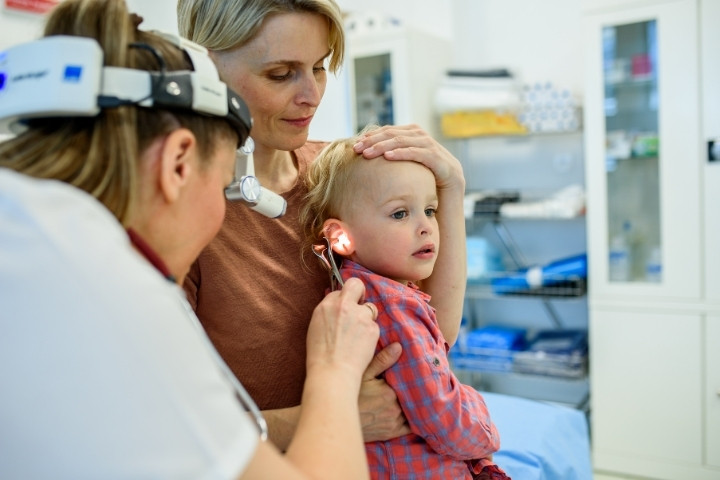
- An otoscope exam to check the ear canal and eardrum
Together, these tools help the audiologist determine not just whether a hearing concern exists, but what type it is, what degree of loss may be present, and what is most likely causing it. The three main types of hearing loss are conductive hearing loss, sensorineural hearing loss, and mixed hearing loss, and each has a different cause and path forward.
This level of detail is simply not possible in a brief screening setting, which is why the referral to an audiologist is such a meaningful step.
What the Referral Process Actually Looks Like
Understanding the mechanics of a referral can help the whole experience feel more manageable.
What Your Pediatrician Communicates to the Audiologist
When your pediatrician sends a referral, they typically share relevant background information about your child, including the reason for the referral, any history of ear infections, screening results, and notes about speech or developmental concerns. This gives the audiologist important context before your child even walks through the door.
At Pediatric Associates of Dallas, the team coordinates closely with audiology specialists to make sure that referral information is communicated clearly and that families are set up for a smooth transition.
What Records and Information to Bring
When you arrive for your child’s first audiology appointment, it helps to come prepared. Consider bringing:
- Any previous hearing screening results from your pediatrician’s office
- Your child’s immunization and medical history if available
- A list of ear infections or illnesses that affected the ears, including dates if you remember them
- Notes on any speech or language milestones you have noticed, or missed
- A list of specific observations you have made at home about how your child responds to sound
- Insurance information and the referral paperwork from your pediatrician
Coming prepared helps the audiologist use the appointment time as efficiently as possible, especially if your child is young or likely to need breaks during testing.
What a First Audiology Evaluation Generally Involves
The first audiology evaluation is typically the most comprehensive visit. The audiologist will begin by reviewing your child’s history with you and asking about your specific concerns. From there, they will conduct the combination of tests listed above, adjusting the approach depending on your child’s age and cooperation level.
For infants and very young children, some tests can be performed while the child is asleep or resting. For older children, tests often involve responding to sounds in a sound booth, which many kids actually find interesting once they understand what they are doing.
The audiologist will explain the results to you before you leave the appointment, and they will walk you through what the audiogram shows and what it means for your child.
How the Pediatrician and Audiologist Coordinate After the Evaluation

Pediatric care works best when providers are communicating with each other, and that coordination happens on the back end of the referral process too.
After the evaluation, the audiologist typically sends a detailed report to your child’s pediatrician summarizing the findings, the type and degree of any hearing concern identified, and any recommendations for next steps. This allows your pediatrician to stay informed and involved in your child’s overall care plan.
Depending on the results, the follow-up recommendations might include:
- A referral to an ENT, or ear, nose, and throat specialist, if a medical cause like fluid or otitis media is identified
- Recommendations for hearing aids for children if a permanent hearing loss is confirmed
- A referral to a speech-language pathologist if language development support is needed
- Early intervention services if the child is under age three and hearing loss is confirmed
- Monitoring and follow-up audiology visits to track hearing over time
- An evaluation for auditory processing disorder if hearing thresholds are normal but processing concerns exist
Your pediatrician will be part of that conversation with you, and you will not be navigating next steps alone.
What Parents Should Know Before the Appointment

A few reminders that can help the whole process go more smoothly:
- Bring something familiar. Young children often do better in new environments when they have a favorite toy or comfort item with them.
- Arrive a little early. New patient paperwork and getting settled in an unfamiliar space takes time, and a relaxed child is easier to test.
- Ask questions freely. The audiologist wants you to leave with clarity, not confusion. No question is too basic.
- Understand that one evaluation may not answer everything. Some hearing concerns require follow-up testing or a second visit before a full picture is available.
Wrapping Up
A referral from your pediatrician to an audiologist in Plano TX is not a reason to panic. It is a signal that your child’s care team is paying attention and wants to make sure they have a complete picture of how your child is hearing. The difference between a routine screening and a full diagnostic hearing evaluation is significant, and the referral is simply the bridge between the two.
Whether the evaluation confirms everything is fine or identifies a concern that needs follow-up, you will leave with more information than you had before, and that is always a good thing for your child’s health.
If your child’s pediatrician has recommended an audiology evaluation, or if you have concerns about your child’s hearing at home, our Dallas and Plano team at Pediatric Associates of Dallas is here to help guide you through every step.