



Did your baby not pass the newborn hearing screening before leaving the hospital? If you are sitting with that result right now, wondering what it means and what you are supposed to do next, take a breath. A failed newborn hearing test is one of the most common results that sends parents home with questions, and it does not automatically mean your child has permanent hearing loss.
What it does mean is that there are clear, time-sensitive steps ahead. And the waiting period between that first screen and the next appointment is not empty time. It is a window to stay informed, observe your baby’s responses, and ask the right questions so that when you do sit down with your pediatrician or audiologist, you are ready.
This guide is designed to walk you through exactly that.
Understanding What a Failed Screen Actually Means

The Difference Between a Screen and a Diagnosis
Newborn hearing screening tests are designed to be sensitive. They catch anything that might be worth investigating, which means they also produce a number of results that do not reflect permanent hearing loss. Factors like fluid in the ear canal, movement during testing, or background noise in the room can all affect the outcome.
A failed newborn hearing test is not a diagnosis. It is a signal that a closer look is needed.
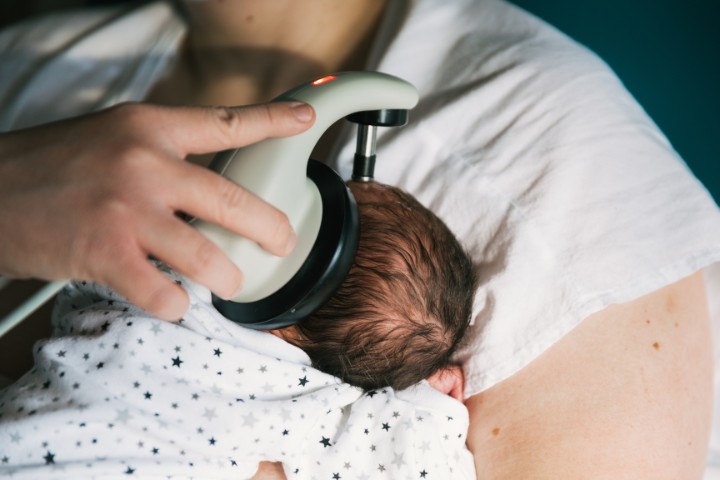
There are two main types of screens used in hospital settings:
- OAE (otoacoustic emissions): Measures sound echoes produced by the inner ear in response to a tone
- ABR (auditory brainstem response): Measures how the auditory nerve and brainstem respond to sound
If your baby did not pass one or both of these, the next step will depend on the specific result and your hospital’s protocol.
What the Numbers Actually Look Like in Texas
Texas participates in the national EHDI (Early Hearing Detection and Intervention) program, administered locally through TEHDI (Texas Early Hearing Detection and Intervention). According to TEHDI follow-up guidelines and Texas Health and Safety Code 47, all Texas birthing facilities are required to screen newborns before discharge and to connect families with follow-up resources when a baby does not pass.
The national 1-3-6 hearing timeline provides the framework:
- Screen by 1 month of age
- Diagnosis completed by 3 months of age
- Early intervention services started by 6 months of age
Texas EHDI benchmarks align with this model. That means if your baby did not pass the birth screen, the clock is already running, but there is still meaningful time if you act promptly.
The Two Possible Next Steps After a Failed Screen
Option One: Outpatient Hearing Rescreen
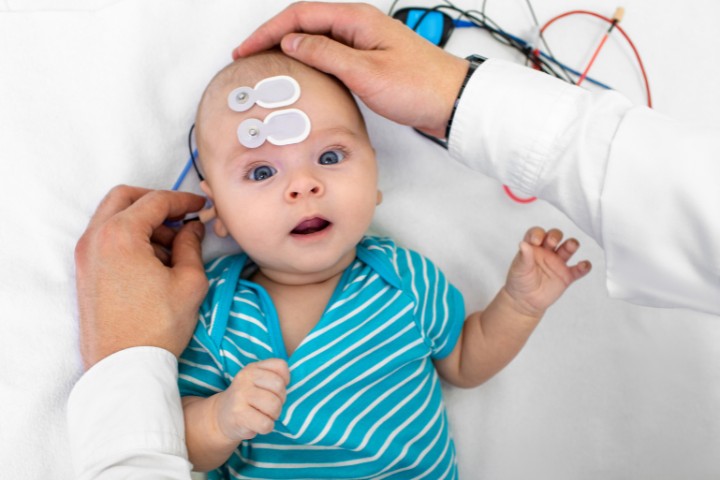
Many hospitals schedule an outpatient hearing rescreen before referring for full diagnostic testing. This is often done around 2 to 4 weeks after birth, once any residual fluid from delivery has cleared. A large percentage of babies who do not pass the birth screen will pass this rescreen with no further follow-up needed.
If your pediatrician or the hospital refers you for a rescreen, keep that appointment. Do not assume the first result was a mistake and skip it.
Option Two: Referral for Diagnostic Audiology Testing
If your baby does not pass the rescreen, or if the initial result was significant enough to warrant skipping directly to diagnosis, you will be referred to a pediatric audiologist for a diagnostic ABR. This is a more detailed evaluation conducted in a controlled setting that gives a much clearer picture of whether hearing loss is present and, if so, what type.
In the Dallas area, pediatric audiology services are available through several facilities. The team at Pediatric Associates of Dallas includes audiologists experienced in working with infants and guiding families through exactly this process.
Ask About CMV Testing Right Away

Why This Is Urgent and Time-Sensitive
This is one of the most important things this article will tell you, and it is often missed in the rush of early appointments.
Congenital CMV (cytomegalovirus), also written as cCMV, is a common congenital infection that can cause sensorineural hearing loss in infants. When a baby does not pass a newborn hearing screen, congenital CMV testing should be considered quickly because the diagnostic window is narrow.
A CMV urine test is only able to confirm congenital infection within the first 21 days of life. After that point, a positive result cannot be distinguished from a postnatal infection, which carries a very different prognosis. Texas has taken steps to increase awareness of CMV follow-up after a failed newborn hearing screen, reflecting the growing recognition that cCMV is one of the leading non-genetic causes of sensorineural hearing loss in infants.
What to Ask Your Pediatrician
At your earliest appointment after a failed screen, ask your pediatrician directly:
- Has congenital CMV testing been ordered?
- Is there still time to collect a urine sample within the 21-day window?
- If CMV is confirmed, what does that mean for our follow-up plan?
You do not need to wait for the audiologist appointment to raise this question. Your pediatrician can order CMV testing, and early action matters here.
What You Can Observe at Home

Reasonable Sound and Communication Behaviors to Watch For
While you are waiting for your rescreen or diagnostic appointment, home observation can give you useful information to share with your care team. You are not testing your child’s hearing. You are simply noticing patterns.
Some behaviors that are normal and reassuring to see in the first few weeks include:
- Startling or blinking at sudden loud sounds
- Pausing or slowing movement when you speak nearby
- Appearing to settle when they hear your voice
- Showing brief eye widening in response to unexpected noise
Keep in mind that newborns sleep heavily, have inconsistent arousal states, and can appear to ignore sounds even when their hearing is completely intact. A lack of obvious response during one feeding or nap does not mean anything on its own.
Why Home Hearing Tests Are Not Reliable
Social media groups and parenting forums are full of well-meaning suggestions for checking your baby’s hearing at home. Clap near their ear. Play a loud tone on your phone. Watch their eyes.
These informal tests are not a substitute for clinical evaluation, and here is why: even babies with moderate to significant hearing loss may still respond to vibration, air movement, or visual cues in a way that looks like a hearing response. The professional screenings used in clinical settings are designed specifically to isolate auditory nerve function from all of those other variables.
Use home observation as a way to gather notes for your care team. Do not use it to reassure yourself that the clinical result was wrong.
Managing Advice From Everyone Around You

Relatives, Social Media, and the Noise in Between
When something concerning happens with a new baby, advice comes fast. Your mother-in-law may be certain it was just fluid. A Facebook group might have ten parents who all passed the rescreen with no issues. A quick search might lead you to a forum where someone says their child had the same result and everything turned out fine.
Some of that is genuinely comforting and may even be statistically accurate. But none of it is your baby’s clinical picture.
A practical mindset for this period is to allow yourself to receive emotional support from your community while reserving medical interpretation for your care team. You can say, kindly, “We are following up with the doctor and waiting on results.” That is a complete answer.
Your job right now is not to diagnose or rule anything out. Your job is to show up to the appointments, ask the right questions, and stay grounded.
Your Waiting Period Observation Log

Keeping a simple log between now and your follow-up appointment gives you something concrete to bring to the table. It also gives your nervous energy a productive outlet.
Here is what to track:
- Date and time of each observation
- What sound occurred (voice, TV, door, clapping)
- What your baby was doing when it happened
- What response, if any, you noticed
- Any questions that come up for your pediatrician or audiologist
You do not need a special app or form. A notes page on your phone works perfectly. The goal is to capture patterns over time, not to draw conclusions from a single moment.
Questions Worth Writing Down Before Your Next Appointment

Going in prepared helps you get more out of every appointment. Here are questions worth asking:
For Your Pediatrician
- What type of screen did my baby not pass, and what does that tell us?
- Are we doing a rescreen first, or going directly to diagnostic audiology?
- Has congenital CMV been discussed, and is it still within the testing window?
- What is the timeline from here, and what are the Texas EHDI benchmarks we are working toward?
For the Audiologist
- What type of hearing loss, if any, has been identified?
- Is this unilateral or bilateral?
- What would early intervention look like from this point?
- What resources does your office connect families with in the Dallas area?
The Takeaway
A failed newborn hearing test is a prompt for action, not a final answer. Most babies who do not pass the birth screen will pass a rescreen. Some will need further evaluation. A smaller number will receive a confirmed diagnosis and go on to receive early intervention that makes a real difference in their language and communication development.
What matters most right now is staying in motion. Schedule the rescreen or diagnostic appointment as quickly as possible. Ask about CMV testing before that 21-day window closes. Keep a simple observation log. And bring your questions to your care team rather than letting online forums do the answering.
You are already doing the right thing by asking these questions early.

If your baby did not pass a newborn hearing screening and you want guidance on next steps, the team at Pediatric Associates of Dallas is here to help. From pediatric audiology to coordinating TEHDI follow-up and CMV testing, PAD supports Dallas-area families through each step of the early hearing detection process. You can schedule an appointment at PAD’s Dallas or Plano clinic to speak with a provider about your child’s care.